With a Universal Power Adapter, output set at 2.85 VDC (and the voltmeter confirms that), connected at A and B, it works.
It takes quite a bit of pressure to screw the rear cap onto the Tube
when the Assembly and batteries are in (putting it all together),
so I thought that maybe there's too much pressure on A
(some broken connection Inside the Assembly?),
so I connected the Universal Power Adapter 2.85 VDC,
pushing Very Hard on A. It still works.
When the two batteries are lined up together, a voltmeter shows there is 2.94 VDC.
Add the Assembly (not inside the Tube) to that line, so A is touching battery #1 Plus, and a piece of wire from battery #2 Minus to B (in my 3rd picture): it does Not work.
I've tried using "Panasonic Super Heavy Duty C" batteries, and "Eveready Classic C" batteries; none will work.
My conclusion so far: this thing won't work, even using GOOD batteries.
But it does work with 2.85 VDC from another source. WHY?!
After giving it some more thought, I realized there is one thing that concerns me:
It takes quite a bit of pressure to screw the rear cap onto the tube.
This made me wonder whether the threads may have been damaged and are no longer tightening completely, or whether slight corrosion is causing poor electrical contact. If so, the contact between Point C and Point E might not be reliable.
If that is the cause, I think it can be checked with the following procedure:
Lightly sand the contact surface at Point C.
Reassemble the light with only the rear cap removed.
Insert a new battery after confirming its voltage is good, and turn the switch on.
Then:
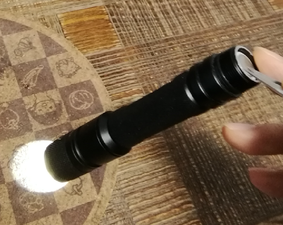
Using tweezers or a similar metal tool, briefly short the battery's negative terminal to Point C.
Please refer to the attached photo.
If my assumption is correct, the light should turn on.
After that, it should be possible to determine whether the problem is caused by damaged threads preventing the rear cap from tightening fully, or by corrosion affecting the electrical contact, and then take the appropriate corrective action.
[ This message was translated with AI assistance. ]

 2


 5
 3

Is the bulb showing continuity?
da honakrisi Condividi
@honakrisi
Continuity? Maybe I don't understand your question.
When the switch is at On, the bulb lights and stays lit.
da Mark578 Condividi
I suspect one of the following might be the case:
・The continuity state changes when the unit is assembled and pressed (between D and E, or at point A).
・There is a specific point where continuity between E and C degrades when the screw is tightened.
da mura mura Condividi
OK, I checked the Continuity of the bulb.
Yes, there is continuity between the two contacts on the bulb.
da Mark578 Condividi
Further confusion:
With a Universal Power Adapter, output set at 2.85 VDC (and the voltmeter confirms that), connected at A and B, it works.
It takes quite a bit of pressure to screw the rear cap onto the Tube
when the Assembly and batteries are in (putting it all together),
so I thought that maybe there's too much pressure on A
(some broken connection Inside the Assembly?),
so I connected the Universal Power Adapter 2.85 VDC,
pushing Very Hard on A. It still works.
When the two batteries are lined up together, a voltmeter shows there is 2.94 VDC.
Add the Assembly (not inside the Tube) to that line, so A is touching battery #1 Plus, and a piece of wire from battery #2 Minus to B (in my 3rd picture): it does Not work.
I've tried using "Panasonic Super Heavy Duty C" batteries, and "Eveready Classic C" batteries; none will work.
My conclusion so far: this thing won't work, even using GOOD batteries.
But it does work with 2.85 VDC from another source. WHY?!
da Mark578 Condividi
Mostra 10 altri commenti